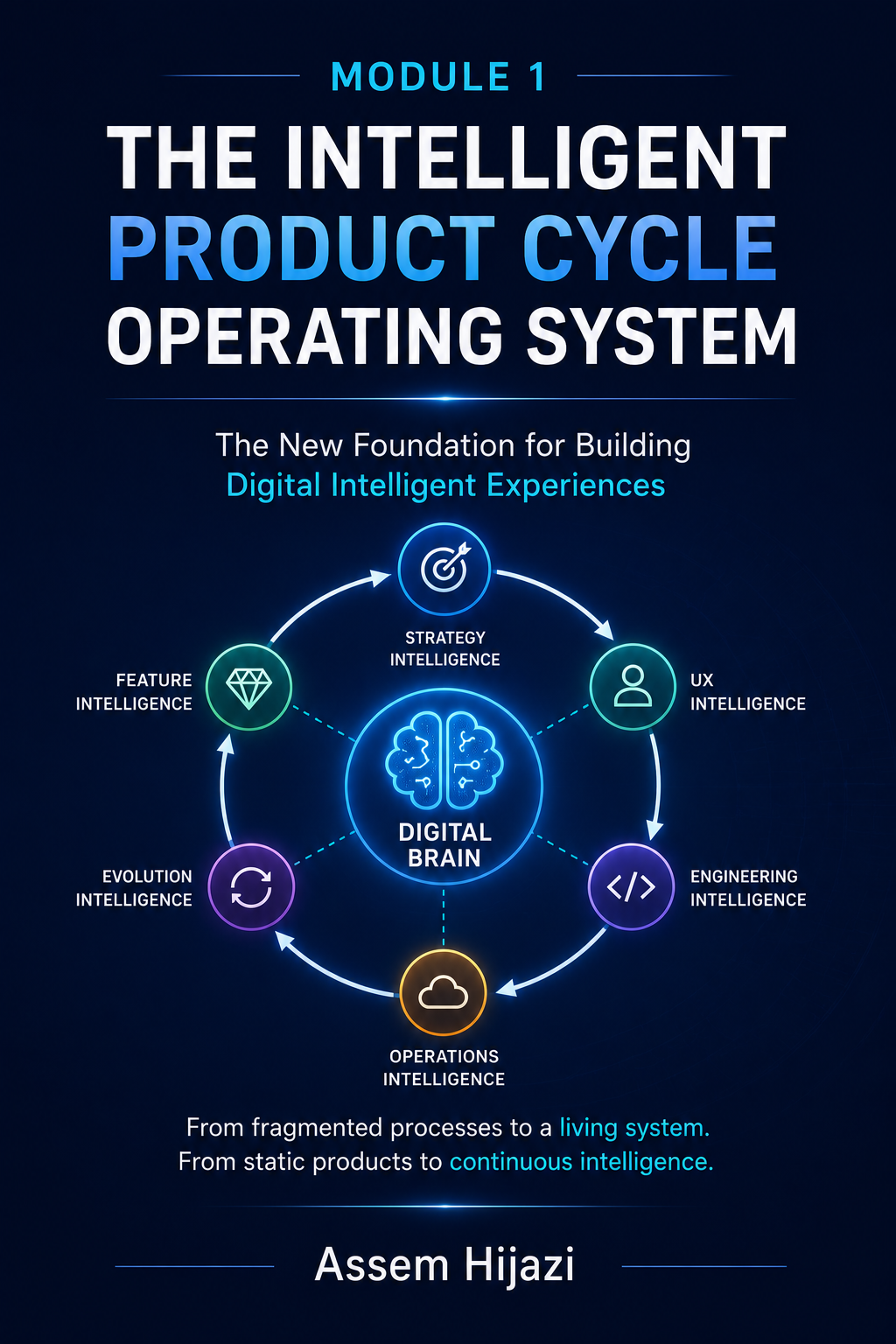
A Unified AI Architecture for the Full Product Development Lifecycle
Framework Type: AI-Driven Product Development & Lifecycle Architecture
Related Book: The Intelligent Product Cycle Operating System — A Unified Claude AI Architecture for the Full Product Development Lifecycle
Author: Assem Hijazi
Framework Overview
The Intelligent Product Cycle Operating System introduces a new architectural approach to building, managing, and continuously improving digital products using artificial intelligence.
Traditional product development often operates through disconnected stages. Strategy teams define requirements, designers create user experiences, developers build applications, and operational teams maintain them. Although AI tools can improve productivity within each stage, the knowledge generated across these activities frequently remains fragmented.
This framework addresses that challenge by introducing a unified operating architecture in which a central Digital Brain participates throughout the entire product lifecycle, supported by a continuously evolving knowledge base, connected workflow engines, structured templates, and human oversight.
Rather than treating AI as a coding assistant or an isolated productivity tool, the framework positions AI as an integrated participant in product strategy, user experience, architecture, engineering, delivery, and continuous improvement.
Its vision is to move beyond faster software development toward intelligent product development, where knowledge is preserved, decisions are connected, and products continuously evolve through accumulated operational intelligence.
The Four Connected Lifecycle Stages
The framework organizes product development into four interconnected stages:
| Stage |
Purpose |
| 1. Strategy and Discovery |
Understand market opportunities, customer needs, product requirements, and strategic priorities. |
| 2. UX and Architecture |
Design user experiences, application structures, interactions, and technical architecture. |
| 3. Engineering and Delivery |
Develop, test, validate, and deliver software through AI-supported engineering workflows. |
| 4. Operations and Evolution |
Monitor performance, analyze feedback, improve features, and continuously evolve the product. |
Unlike traditional sequential development, these stages share intelligence continuously, allowing information generated at any point to influence decisions across the entire lifecycle.
The Nine Architectural Components
The Intelligent Product Cycle Operating System is built around nine connected components, divided into six core components and three continuous-cycle components.
| Component |
Primary Role |
| Digital Brain |
Central AI intelligence supporting decisions and activities across the lifecycle. |
| Project |
Unified environment containing the product’s lifecycle, knowledge, engines, and intelligence. |
| Unified Cycle |
Connects the four product development stages into one continuous process. |
| Cycle Engines |
Govern workflows and AI participation within each stage. |
| Knowledge Base |
Preserves and connects product information, decisions, history, and operational knowledge. |
| Templates |
Structure human input, AI instructions, knowledge capture, and workflows. |
| UX Intelligence System |
Continuously improves user experiences using information from across the lifecycle. |
| Feature Intelligence System |
Continuously evaluates and evolves product features based on requirements, usage, and feedback. |
| Dashboard |
Provides visibility, operational control, and human governance across the system. |
Together, these components establish an architecture in which AI can access relevant lifecycle knowledge rather than working through disconnected conversations.
Three Modes of AI Participation
The framework introduces three complementary modes defining how the Digital Brain participates in product development:
Assist: AI supports human professionals through research, analysis, recommendations, planning, and decision support.
Operate: AI executes defined activities and workflows within established operational boundaries.
Review: AI evaluates outputs, identifies potential issues, checks consistency, and supports quality assurance.
These modes can operate together across different lifecycle stages, allowing organizations to balance human expertise, AI execution, and systematic validation.
Continuous Intelligence and Product Evolution
A central principle of the framework is that product intelligence should not disappear when a task, project stage, or AI conversation ends.
The Knowledge Base preserves information generated throughout development, including research findings, architecture decisions, user experience insights, engineering history, customer feedback, and operational performance.
The Digital Brain can then use this accumulated information to support future decisions.
Importantly, the framework also treats user experience and feature development as continuous intelligence systems rather than activities completed once before release.
This creates a feedback-driven product lifecycle in which applications can be regularly evaluated and improved as requirements, user behavior, and business conditions change.
Practical Applications
The framework is designed to support organizations, software development teams, product managers, architects, and AI application developers who want to:
- Integrate AI across the complete software and product development lifecycle.
- Reduce fragmentation between strategy, design, engineering, and operations.
- Establish a centralized knowledge foundation for product development.
- Standardize AI participation through structured workflows and templates.
- Maintain human governance over AI-assisted and AI-operated activities.
- Continuously improve user experiences and product features.
- Build a foundation for more intelligent and adaptive digital applications.
What Makes This Framework Different?
The framework moves beyond the conventional approach of adding AI tools to existing development processes.
Its central contribution is an integrated operating architecture designed to connect the intelligence generated across every stage of a product's lifecycle.
Although the accompanying book uses Claude AI and Claude Code as its primary operational examples, the underlying architecture is intended to remain adaptable to other advanced AI platforms.
The framework therefore focuses on a broader transformation: from isolated AI-assisted development to unified, continuously evolving product intelligence.
Strategic Value
The Intelligent Product Cycle Operating System offers a conceptual foundation for organizations seeking to rethink how digital products are designed, developed, operated, and improved in the AI era.
It proposes an environment where AI is not simply an additional tool, but a structured part of the product development operating model.
By connecting knowledge, workflows, human expertise, and AI participation, the framework aims to make product development more consistent, adaptive, and informed across successive development cycles.
Core Principle
The future of AI application development is not simply writing code faster. It is building an intelligent product lifecycle in which knowledge, decisions, and improvements remain connected from beginning to end.