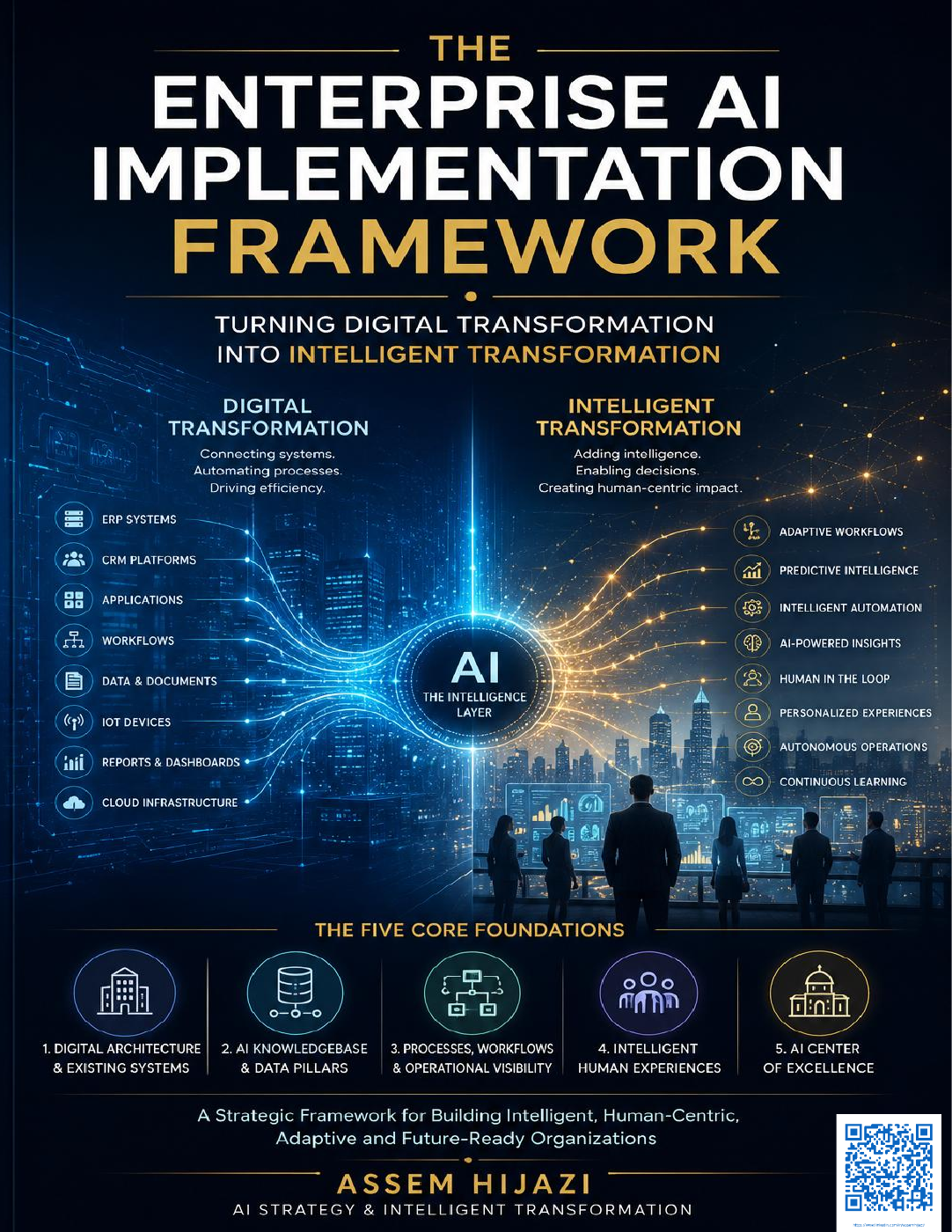
From Digital Transformation to Intelligent Transformation
The Enterprise AI Implementation Framework, developed by Assem Hijazi, provides a connected approach to implementing AI across enterprises and governments. It starts with the systems, knowledge, processes, and people already present in an organization, then identifies how intelligence can improve their operation and experience.
The framework treats AI adoption as a continuously evolving transformation journey. ERP, CRM, applications, infrastructure, and digital workflows provide a foundation to assess and enhance, while new solutions can be developed where the business need requires them.
The Five Core Foundations
| Foundation |
Role in the framework |
| 1. Digital Architecture & Existing Systems |
Map ERP, CRM, applications, integrations, infrastructure, and operational systems to understand current capabilities, dependencies, and gaps. |
| 2. AI Knowledgebase & Data Pillars |
Organize structured data, documents, media, analytics, IoT, and networking information into a relevant, governed knowledge foundation. |
| 3. Processes, Workflows & Operational Visibility |
Make internal and external processes visible and measurable; identify where AI, automation, robotics, and human judgment belong. |
| 4. Intelligent Human Experiences |
Define improved experiences for employees, customers, citizens, executives, and operational teams, based on their context and needs. |
| 5. AI Center of Excellence |
Coordinate adoption, governance, innovation, implementation priorities, and continuous evolution across the organization. |
The Eight-Phase Implementation Lifecycle
| Phase |
Implementation focus |
| 1. Digital Assessment & Visibility |
Assess architecture, systems, workflows, integrations, operational gaps, and organizational readiness. |
| 2. Knowledgebase & Data Foundation |
Identify, organize, and prepare the knowledge sources needed for the selected domains. |
| 3. Workflow & Process Intelligence |
Map processes, identify opportunities, and define automation and human-in-the-loop responsibilities. |
| 4. Intelligent Experience Design |
Specify how intelligence should improve the experience of each target user group. |
| 5. AI Opportunity Prioritization |
Compare opportunities by business value, human value, feasibility, ROI, and strategic alignment. |
| 6. AI Integration & Deployment |
Introduce appropriate capabilities into systems, applications, workflows, and operational environments. |
| 7. Governance, Security & Human Oversight |
Apply policies, ethics, compliance, security, risk management, explainability, and supervision. |
| 8. Continuous Learning & Optimization |
Review and improve knowledge, models, processes, experiences, and operational performance. |
The phases form a flexible roadmap. They can overlap or begin at different points depending on organizational maturity. Governance and oversight should be present from the beginning and continue throughout implementation.
Three Dimensions to Keep Aligned
| Dimension |
What it connects |
| Technology |
Systems, integrations, infrastructure, models, automation, and technical capabilities. |
| Operations |
Processes, workflows, governance, performance, efficiency, and scalability. |
| People |
Trust, adoption, collaboration, ethics, accessibility, and employee and customer experiences. |
How the Foundations Work Together
Architecture assessment shows what the organization operates. The knowledgebase connects what it knows. Workflow visibility reveals how work moves. Experience design defines who benefits and how. The AI Center of Excellence coordinates these foundations and keeps implementation aligned as capabilities and business needs evolve.
Human Readiness and Responsible Implementation
The framework emphasizes vendor-independent awareness for leaders and managers, realistic expectations, and domain-specific design. Healthcare, government, retail, banking, construction, and other environments require different knowledge, priorities, and controls.
Data governance, privacy, security, transparency, accountability, and human intervention support the implementation lifecycle. AI recommendations and actions must fit the organization’s responsibilities and the consequences of each use case.
Strategic Value
- Connect AI investment to existing digital assets and business objectives.
- Build a coordinated knowledge and operational foundation for enterprise intelligence.
- Prioritize opportunities according to feasibility and meaningful value.
- Improve human experiences alongside operational performance.
- Establish a scalable approach that can adapt as technologies and requirements change.
Core principle: AI is not replacing digital transformation—it is evolving it into intelligent transformation.