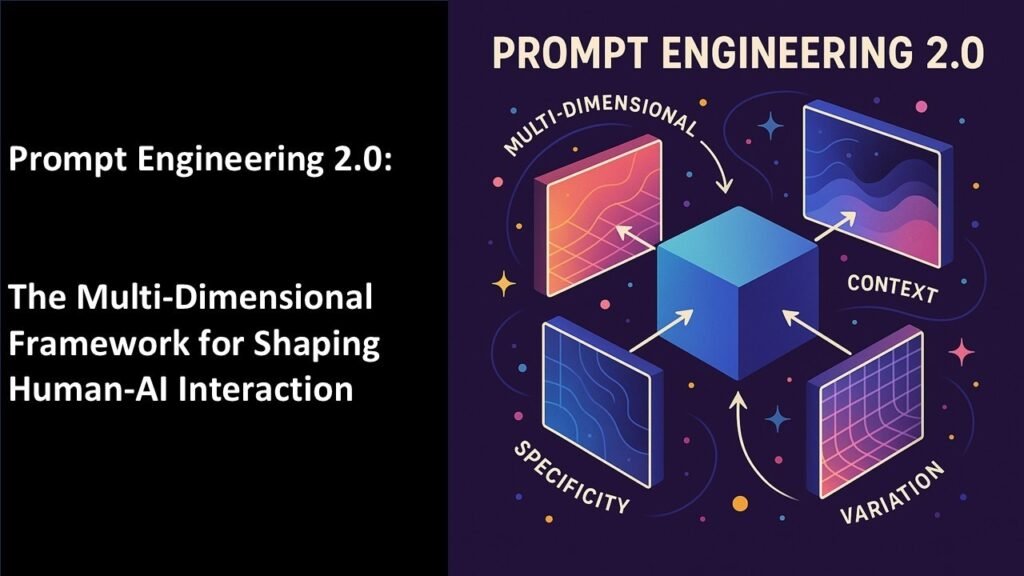
The Multi-Dimensional Framework for Shaping Human–AI Interaction
Related Article: Prompt Engineering 2.0: The Multi-Dimensional Framework for Shaping Human-AI Interaction (Article 146)
Author: Assem Hijazi
Framework Overview
Prompt Engineering 2.0 introduces a multi-dimensional approach to designing and controlling interactions with artificial intelligence.
Rather than treating prompting as simply writing better questions, the framework views every AI interaction as a combination of dimensions that influence how AI interprets instructions, generates responses, adapts its communication, and structures its outputs.
The framework organizes these dimensions into six interconnected categories, allowing users to combine different controls to achieve more relevant, consistent, and purposeful AI responses.
The Six Core Categories
| Category |
Description |
| 1. Intent & Context Control |
Defines the task, scenario, AI role, timeframe, and clarity of instructions. |
| 2. Behavior & Creativity Control |
Guides creativity, response depth, length, variation, and repetition through behavioral instructions and supported model parameters. |
| 3. Tone & Emotional Framing |
Shapes communication style, emotional expression, confidence, and brand voice. |
| 4. Structural Formatting |
Defines output formats, layouts, content structures, presentation styles, and length boundaries. |
| 5. Domain & Audience Adaptation |
Adapts responses to specific industries, audiences, expertise levels, languages, and cultural contexts. |
| 6. Meta & Session-Level Controls |
Addresses memory, tool access, ethical boundaries, multi-step prompting, and feedback-based refinement. |
How the Framework Works
The framework allows users to select and combine dimensions according to their objectives.
For example, a user can instruct AI to act as a business consultant (Intent & Context), explain a strategy in a professional tone (Tone & Emotional Framing), present findings in a table (Structural Formatting), and tailor recommendations for senior executives (Domain & Audience Adaptation).
This approach transforms prompting into a structured process of Human–AI Conversation Design.
Practical Applications
Prompt Engineering 2.0 supports:
- Professional Communication: Creating content tailored to specific audiences, roles, and communication styles.
- Business Analysis: Producing structured reports, comparisons, and recommendations.
- AI Application Development: Designing reusable prompt configurations for AI-powered applications.
- Education & Research: Adjusting explanations to different knowledge levels and learning objectives.
- Enterprise AI Adoption: Standardizing AI interactions across departments and workflows.
Strategic Value
The framework helps users move from trial-and-error prompting toward intentional interaction design.
By understanding and combining multiple prompting dimensions, individuals and organizations can improve the relevance, structure, consistency, and usability of AI-generated responses.
Some technical parameters, such as temperature and Top-P, require platform or API support and cannot necessarily be changed through ordinary prompt text.
Core Principle: Effective prompting is not about finding the perfect sentence. It is about designing the right combination of dimensions to guide AI toward the desired outcome.