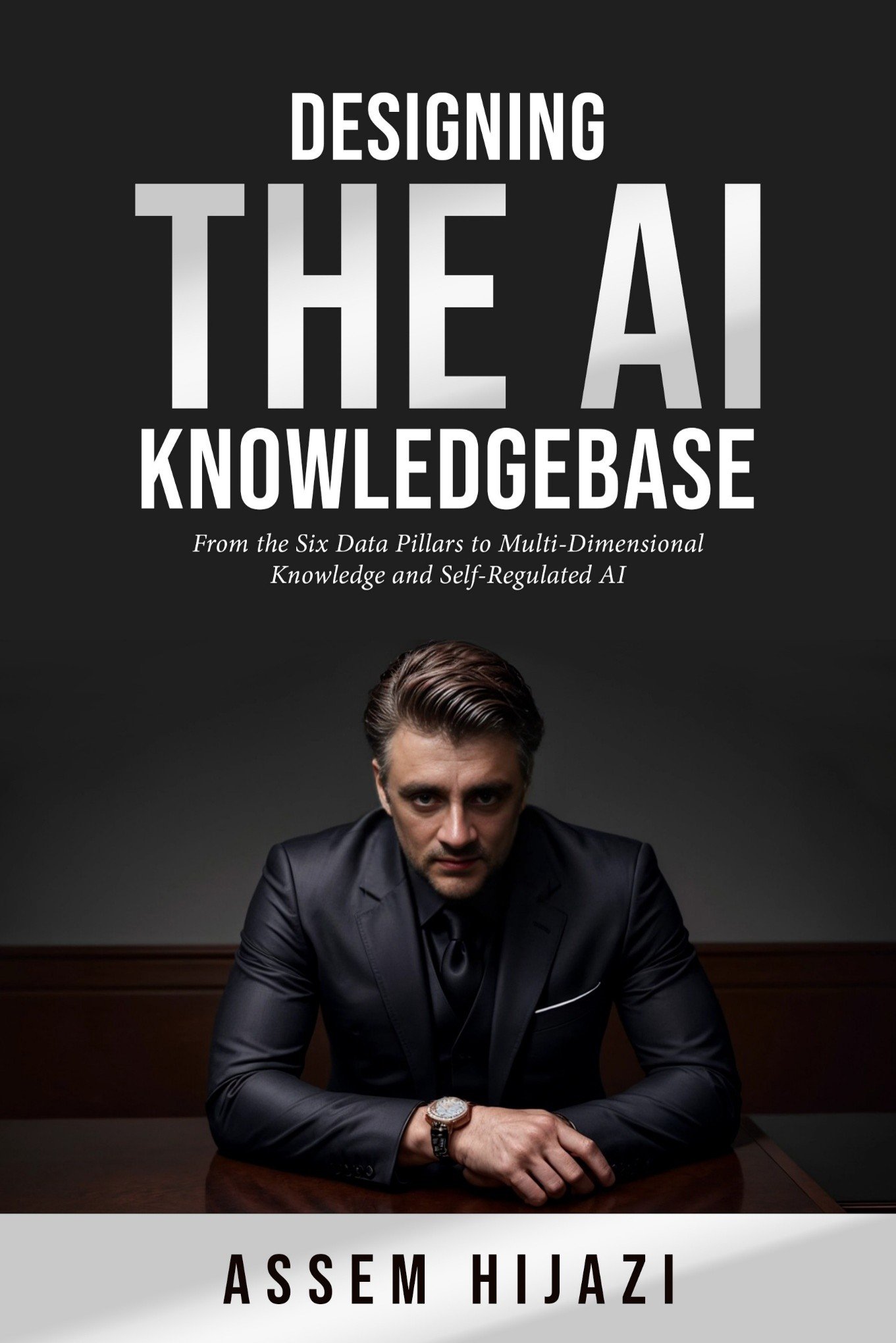
From the Six Data Pillars to Multi-Dimensional Knowledge and Self-Regulated AI
Framework Description
The Designing the AI Knowledgebase Framework, developed by Assem Hijazi, introduces a comprehensive architectural approach to preparing organizations, enterprises, and governments for artificial intelligence.
The framework is built on a fundamental principle: AI intelligence depends not only on the capabilities of AI models but also on the quality, structure, connectivity, governance, and depth of the knowledge available to them.
While many organizations focus on selecting AI models, deploying chatbots, or connecting existing systems through APIs, this framework addresses a more fundamental challenge: how to transform fragmented organizational information into a unified, continuously evolving knowledge environment capable of supporting intelligent reasoning, decision-making, automation, and innovation.
Rather than treating a knowledgebase as a collection of documents or a conventional database, the framework introduces an integrated architecture connecting multiple forms of enterprise information, operational systems, digital infrastructure, and contextual knowledge.
The Framework’s Five Foundational Dimensions
1. The AI Mindset
Establishing the strategic understanding required for successful AI adoption. The framework emphasizes organizational readiness, leadership awareness, and the importance of designing AI around business objectives rather than adopting technology in isolation.
2. The Six Data Pillars
Organizing enterprise knowledge across six interconnected data domains, covering structured and unstructured information, digital content, operational environments, connected devices, and networking infrastructure.
These pillars establish the information foundation required to support AI systems across different organizational functions and technological environments.
3. The AI Knowledgebase Architecture Design Center
Introducing a centralized architectural approach for connecting, organizing, governing, and managing knowledge across the six pillars.
The Architecture Design Center serves as the structural foundation for enterprise AI readiness, enabling organizations to establish consistent knowledge relationships, access controls, integration mechanisms, and governance principles.
4. Multi-Dimensional Knowledge
Moving beyond isolated data categories by introducing multiple contextual dimensions across the knowledgebase.
The framework demonstrates how combining operational, financial, customer, market, organizational, technological, and strategic perspectives can create richer knowledge relationships.
This multi-dimensional approach is intended to help AI systems move beyond basic information retrieval toward deeper contextual analysis, cross-domain reasoning, informed recommendations, and creative problem-solving.
5. Self-Regulated AI
Introducing an additional governance and intelligence-control layer designed to continuously monitor AI behavior, evaluate actions, detect unexpected outcomes, and support responsible intervention.
This dimension recognizes that increasingly autonomous AI systems require more than traditional access controls and static governance policies. They require continuous oversight, accountability, and alignment with human and organizational objectives.
Strategic Value and Applications
The framework provides a foundation for organizations seeking to move from disconnected AI experiments toward a coordinated enterprise intelligence ecosystem.
Its applications extend across enterprise systems such as ERP and CRM, operational technologies, IoT environments, digital services, government platforms, and other information-intensive environments.
By connecting data, knowledge, context, governance, and AI intelligence within a unified architectural vision, the framework aims to support:
- Improved AI accuracy, relevance, and contextual understanding.
- More intelligent decision-making across departments and business functions.
- Stronger integration between structured and unstructured organizational knowledge.
- Better alignment between AI capabilities and strategic objectives.
- Continuous knowledge development rather than isolated AI interactions.
- Responsible AI operations supported by governance and self-regulation.
- Scalable foundations for enterprise, government, and future advanced AI environments.
The Long-Term Vision
The Designing the AI Knowledgebase Framework proposes a shift from building AI solutions around individual models toward building an enduring knowledge architecture that can support different AI technologies over time.
Its central vision is to create a living, multi-dimensional, governed knowledge ecosystem where organizational intelligence can be connected, expanded, and continuously improved.
The ultimate objective is not simply to make AI systems more knowledgeable, but to establish the architectural foundation for AI systems that are more contextual, capable, trustworthy, and strategically valuable.
Related Publication: Designing the AI Knowledgebase – From the Six Data Pillars to Multi-Dimensional Knowledge and Self-Regulated AI
Author: Assem Hijazi