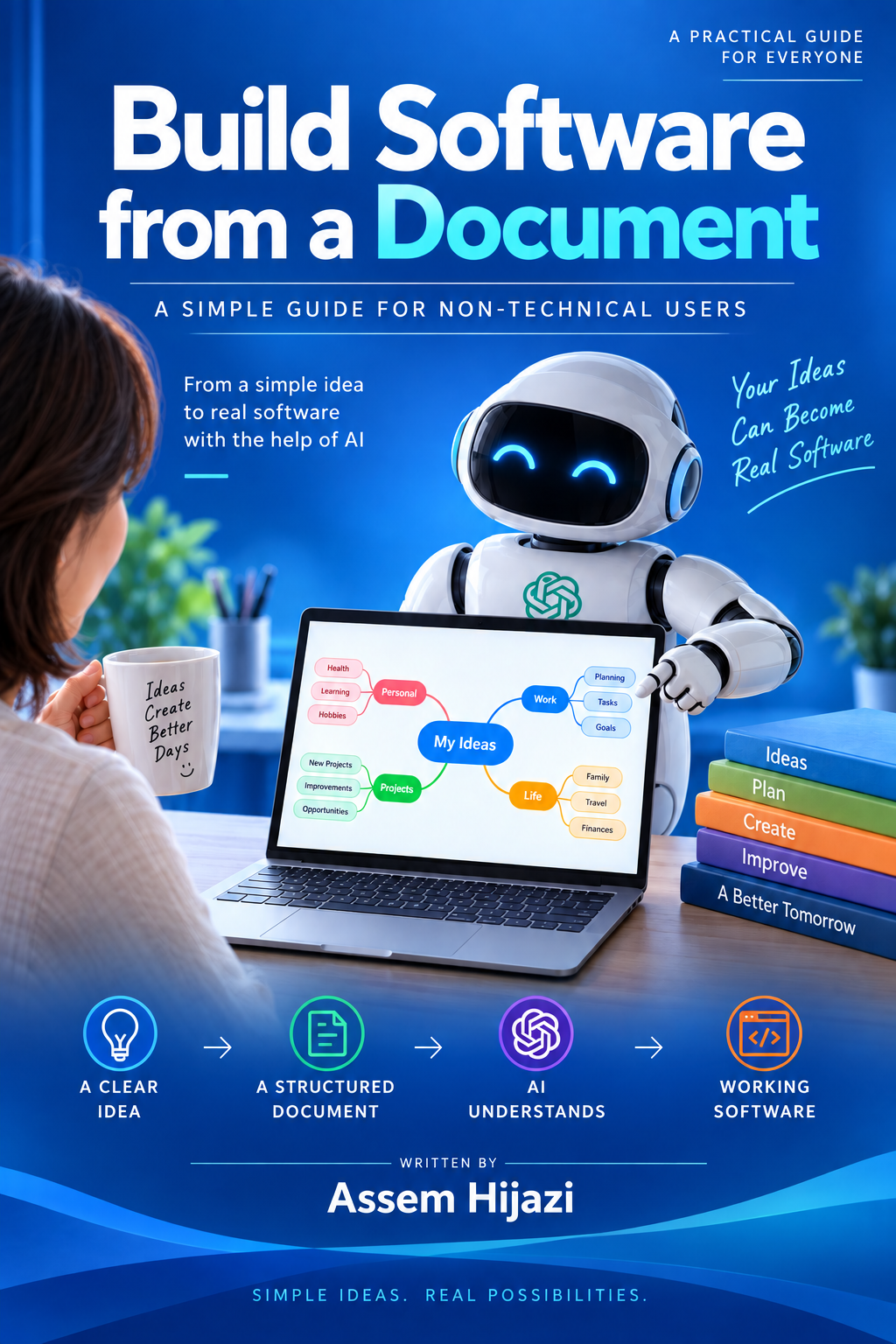
From Human Knowledge to Working AI-Generated Applications
Framework Type: AI-Assisted Software Development Methodology
Framework Overview
Build Software from a Document introduces a human-centered methodology for transforming software ideas into functional applications using artificial intelligence.
The framework challenges the traditional assumption that developing software must always begin with programming knowledge. Instead, it proposes that a well-structured document can become the foundation for AI-assisted software creation.
The central idea is straightforward: humans define what the software should accomplish, while AI translates that knowledge into a working application.
Rather than relying on fragmented prompts, the methodology organizes the application's purpose, structure, functionality, behavior, user interface, data requirements, constraints, and acceptance criteria into a comprehensive document that AI can interpret and implement.
Core Methodology
The framework follows eight interconnected stages:
- Define: Establish the software idea, objectives, and intended users.
- Document: Translate the idea into a structured, understandable specification.
- Educate AI: Provide the document as the knowledge foundation for development.
- Build: Allow AI to translate the requirements into functional software.
- Use: Run the application in its intended environment.
- Evaluate: Test functionality, usability, and alignment with the requirements.
- Change: Describe improvements or corrections in natural language.
- Build Again: Use AI to implement the next version while preserving existing functionality.
This creates a continuous development cycle in which the software evolves through collaboration between human knowledge and AI capabilities.
Framework Components
The methodology addresses several important dimensions of AI-assisted application development:
- Structured Software Documentation: Defining requirements in language understandable to both humans and AI.
- Application Architecture: Describing the application's main components, navigation, interfaces, and relationships.
- Functional Requirements: Specifying how features should behave rather than simply how they should appear.
- Data Management: Establishing requirements for storage, backup, restoration, import, and export.
- AI Build Advisory: Providing instructions that guide AI during software implementation.
- AI Change Advisory: Supporting controlled modifications and future application versions.
- Validation and Acceptance: Evaluating the delivered application against documented requirements.
Practical Demonstration: Mind Mapping Application
The document demonstrates the methodology through a browser-based Mind Mapping Application.
This example brings together interactive visual elements, hierarchical information structures, editing capabilities, navigation, customization, data storage, and export functionality.
The application serves as a practical test of whether AI can transform structured human knowledge into usable software, rather than merely generating interface designs or code samples.
Strategic Value
The framework creates opportunities for individuals, business professionals, educators, and organizations to participate more directly in software development.
It can help teams prototype internal applications, test ideas, translate operational knowledge into digital tools, and iteratively improve software without requiring the original idea owner to write code.
Importantly, the framework does not claim that AI eliminates the need for software engineers. Instead, it redefines how humans and AI can collaborate, making software creation more accessible while retaining the importance of validation, technical judgment, and quality assurance.
Framework Principle
Human Knowledge + Structured Document + AI Capability → Working Software
The document becomes more than a traditional specification. It becomes an actionable knowledge foundation that AI can use to build, validate, and evolve software.
Build Software from a Document represents a practical approach to AI-assisted application development, where the quality of human knowledge and structured documentation plays a central role in determining the quality of the resulting software.