Short description
A practical, business-friendly guide to designing, building, and scaling Claude AI Skills and Virtual AI Teams. Written by Assem Hijazi, this second edition introduces a structured 10-layer Skill Template Framework, explains how plugins, connectors, workflows, and knowledge sources work together, and provides a step-by-step example for building, testing, and improving reusable AI operational capabilities. Designed for business professionals, AI enthusiasts, and technical practitioners.
Book information
- Category
- AI Assistant
- Subcategory
- Claude
About this book
Claude AI Operational Skills Playbook – Second Edition is a practical guide by Assem Hijazi that explores how organizations and individuals can move beyond traditional AI conversations toward structured AI operational capabilities and virtual AI teams.
The book introduces a business-friendly framework for understanding Claude AI Skills, designing reusable AI workflows, and organizing intelligent capabilities around business roles and operational responsibilities.
Rather than focusing on complex programming, the book explains how to build practical AI capabilities through structured instructions, workflows, plugins, connectors, knowledge sources, and human oversight.
What the Book Covers
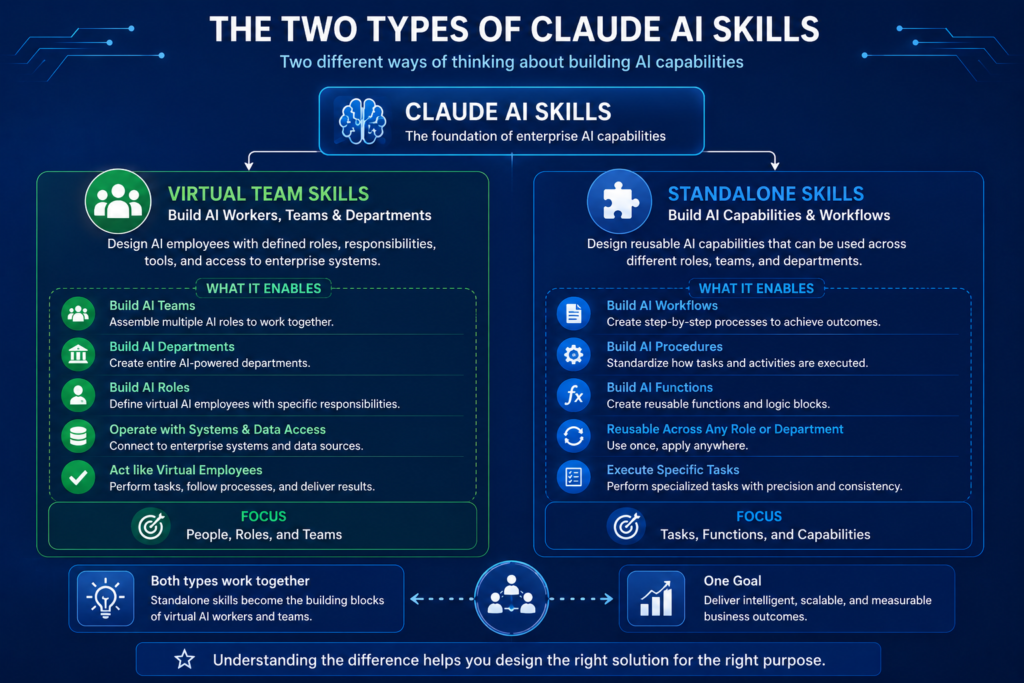
Chapter 1: Understanding Claude AI Skills: From Standalone Capabilities to Virtual AI Teams
Introduces the two main approaches to organizing Claude AI Skills: standalone reusable capabilities and skills grouped around virtual AI roles. It explains how these approaches can support business operations and organizational productivity.
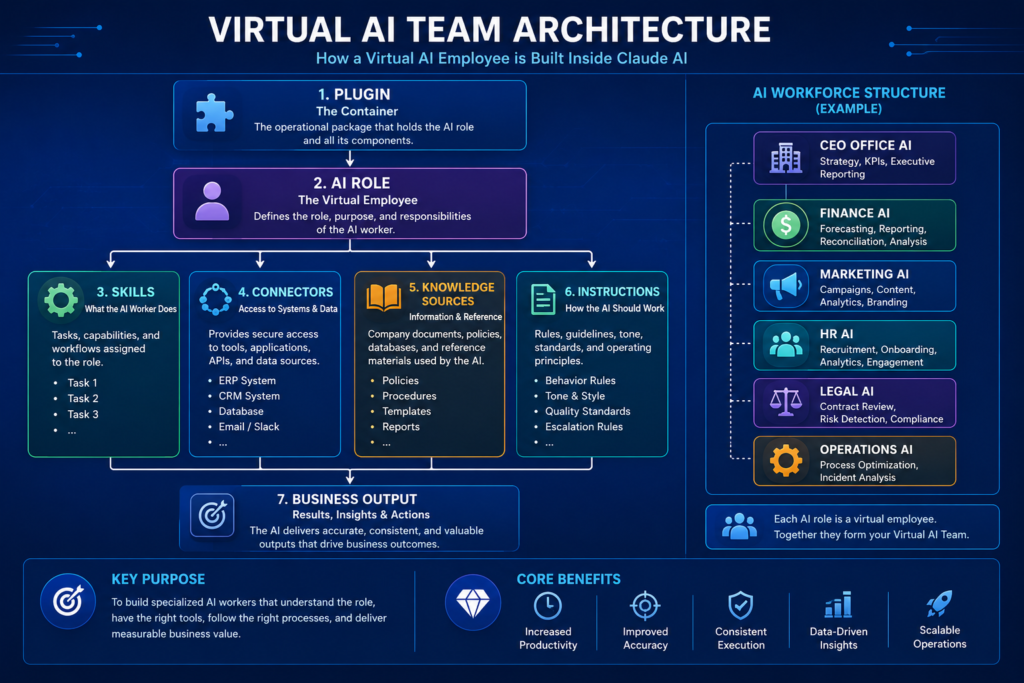
Chapter 2: Building Virtual AI Teams with Claude AI: From Plugins to AI Workforce Architecture
Explores the concept of virtual AI employees and operational teams. It explains how plugins, skills, connectors, company instructions, and knowledge sources can be combined to support roles such as AI Finance Analysts, Marketing Managers, Legal Assistants, and Executive Assistants. It also examines the current limitations of virtual AI workforce architectures.
Chapter 3: Understanding Standalone Claude AI Skills: What We Give to Claude vs. What We Assign to AI Roles
Clarifies the difference between operational capabilities provided to Claude and responsibilities assigned to virtual AI workers. It introduces different categories of AI skills, including writing, analysis, research, workflow management, integration, and automation.
Chapter 4: Designing Claude AI Skill Templates: Building Reusable AI Operational Capabilities
Introduces the book's 10-layer Skill Template Framework, a standardized approach for designing reusable AI capabilities. The framework covers basic information, instructions, workflows, prompt structures, operational logic, connectors, knowledge sources, inputs and outputs, human oversight, and limitations.
Chapter 5: From Template to Reality: Building Your First Claude AI Skill Step by Step
Provides a practical walkthrough for designing and implementing a Meeting Summary Skill. Readers learn how to complete the skill template, configure the capability within Claude AI, test its output, identify problems, and improve the results through an iterative development process.
Visual Frameworks and Practical Resources
The second edition also includes architectural diagrams, infographics, a visual executive summary, a 10-layer framework illustration, a Virtual AI Team architecture diagram, a Skills Development Lifecycle, and a printable Claude AI Skill Template Canvas.
Who Should Read This Book?
The book is intended for business leaders, department managers, AI enthusiasts, consultants, IT professionals, and anyone interested in understanding how AI can support operational responsibilities within organizations.
It is particularly useful for readers who want to explore AI capabilities without starting with complex programming or software development.
The Central Message
The future of enterprise AI is not simply about asking AI assistants questions. It is about designing structured, reusable, and governed intelligent capabilities that can support real business processes.
By combining AI skills, workflows, knowledge sources, system connections, and human oversight, organizations can begin building practical foundations for more advanced AI-powered operational environments.
This second edition focuses on the standard Claude AI environment. Claude Code and more advanced developer-oriented capabilities are planned for future volumes.
Book infographics