What Is AI? The Journey of Cloning the Human Brain Through Four Elements
Introduction
Artificial Intelligence is everywhere today. Everyone is talking about it. Everyone is using it. But if we ask a very simple question: What is AI, really?
Most answers will talk about tools, software, or technologies. But this is not the real picture.
AI did not start recently.
It started many years ago with one big ambition: To understand the human brain… and try to recreate it. This is the real story of AI.
From early decision trees… to machine learning… to neural networks… to today’s generative AI… All of these are not separate technologies.
They are steps in one journey: The journey of building a digital brain.
The journey of building a digital brain.
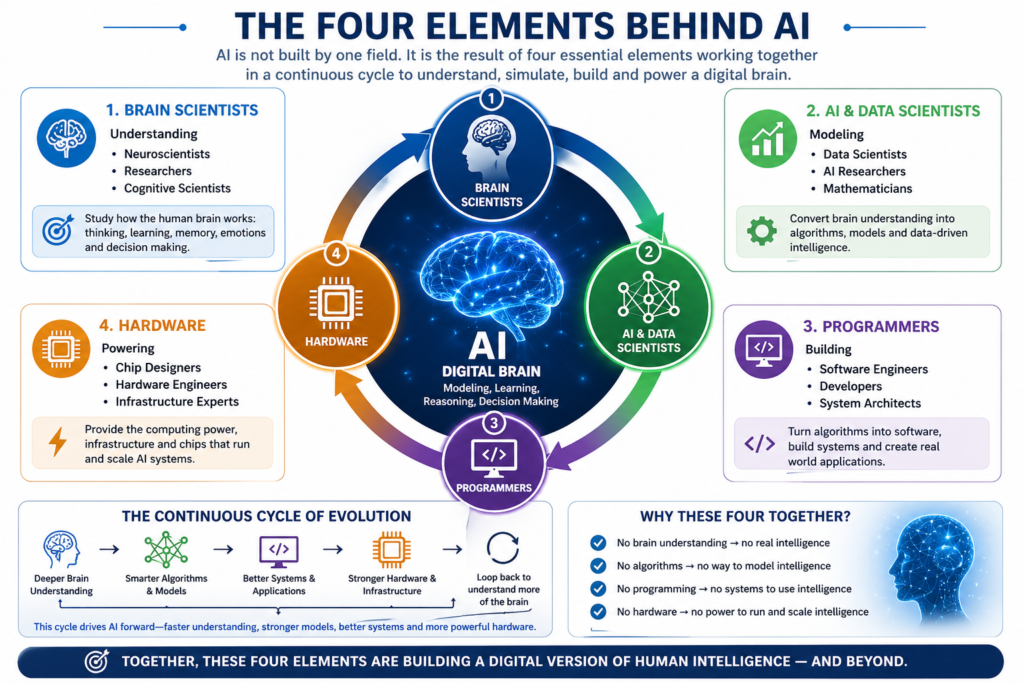
AI is not created by programmers alone. And it is not created by data scientists alone. Instead, it is the result of four main elements working together:
Scientists who study the human brain
Experts who convert this understanding into algorithms
Programmers who turn algorithms into systems
Hardware that makes all of this possible
The more these elements integrate… The closer we get to simulating the human brain… And in some areas, AI is already going beyond human capabilities — especially in speed, memory, and data processing.
Machine learning
However, there is one important thing to understand: You cannot understand AI without understanding Machine Learning. Machine Learning is the starting point — the first step where machines begin to learn from data. But AI does not stop at learning. It continues toward something bigger: Thinking, decision-making, and possibly… surpassing human intelligence.
Because in the end… Understanding AI is not about understanding machines. It is about understanding ourselves — and how we think.
The Four Elements Behind AI
To truly understand AI, we need to move away from the idea that AI is just software or tools. AI is the result of four major elements working together over many years. Each element plays a critical role in building what we call today: The Digital Brain
The Four Elements Behind AI
| Element | Role | Simple Description |
| Brain Scientists | Understanding | Study how the human brain thinks, learns, and makes decisions |
| Data & AI Scientists | Modeling | Convert brain understanding into algorithms and mathematical models |
| Programmers | Building | Turn algorithms into real software and AI systems |
| Hardware | Powering | Provide the computing power to run and scale AI systems |
1. Brain Scientists (Understanding the Human Brain)
Everything starts here.
These are:
Neuroscientists
Researchers
Doctors
Professors
Their role is simple but very complex:
Understand how the human brain works
How we think
How we remember
How we make decisions
How neurons connect and communicate
Without this understanding, AI would have no direction. Because: You cannot clone something you don’t understand.
2. Data Scientists & AI Scientists (Turning Brain into Algorithms)
Once we understand parts of the human brain… The next step is to translate that understanding into mathematics.
This is where:
Data Scientists
AI Engineers
Researchers
come in.
They build:
Algorithms
Models
Mathematical formulas
These are attempts to simulate:
Thinking
Learning
Decision-making
Example:
Early decision trees tried to simulate how humans choose between options
(like in chess — multiple possible moves with probabilities). This is the moment where human thinking becomes digital logic.
3. Programmers (Building the Digital System)
Algorithms alone are not enough. Someone needs to turn them into real systems.
This is the role of:
Software Engineers
Programmers
They:
Write code
Build applications
Connect systems
Create platforms
They transform ideas into working AI systems.
Without programmers:
Algorithms stay theoretical
AI cannot exist in real life
4. Hardware (Powering the Digital Brain)
Now comes a very important part that many people underestimate: Hardware
The human brain is extremely powerful.
To simulate even a small part of it, we need:
Strong processors (GPUs, AI chips)
Massive infrastructure
High-speed memory
Hardware is what allows AI to:
Process huge data
Run complex models
Scale globally
And here is a key insight: The evolution of AI is directly linked to the evolution of hardware.
The Integration Between the Four Elements
These four elements do not work separately.
They are deeply connected:
Brain research improves algorithms
Algorithms require better programming
Programming demands stronger hardware
Hardware enables more advanced brain simulation
This creates a continuous cycle: More understanding → Better simulation → More powerful AI
The Big Picture
The more these four elements evolve together: The closer we get to building a real digital brain
And not only that… In some areas, AI already exceeds human capabilities:
Speed
Memory
Data processing
And this is just the beginning. Because this integration will continue…
Leading to:
Smaller and more powerful AI systems
Advanced AI chips
And possibly… micro digital brains in the future
Key Takeaway
AI is not one invention. It is a collaboration between four worlds:
Science
Mathematics
Software
Hardware
And together, they are building something extraordinary: A digital version of human intelligence — and beyond.
The AI Journey: From Simple Logic to the Digital Brain
To understand AI deeply, we should not see it as one technology. AI is a journey of evolution — step by step, getting closer to how the human brain works.
Let’s walk through this journey in a simple way, while comparing it to the human brain.
The AI Journey: From Simple Logic to the Digital Brain
| Stage | AI Evolution | What It Means | Human Comparison |
| Stage 1 | Simple Logic | Rules, if/else, decision trees | Like a human following strict instructions |
| Stage 2 | Machine Learning | Learning from data and patterns | Like learning from experience (but without understanding) |
| Stage 3 | Neural Networks | Simulating brain structure (neurons & connections) | Like mimicking how the brain is built |
| Stage 4 | Generative AI | Communication, creation, human-like interaction | Like speaking and expressing ideas |
| Stage 5 | Digital Brain (Future) | Integrated intelligence beyond human limits | Toward surpassing human thinking |
Stage 1: Simple Logic (The Beginning)
AI started with very basic ideas:
Rules
If/Else logic
Decision trees
Think of it like:
A human following strict instructions
No creativity
No learning
Example:
If X happens → do Y
Human vs AI
| Capability | Human | AI |
| Flexibility | ✅ High | ❌ Very limited |
| Learning | ✅ Yes | ❌ No |
| Speed | ❌ Limited | ✅ Fast |
At this stage:
AI is fast
But humans are far more intelligent
Stage 2: Machine Learning (Learning Begins)
This is where AI becomes more interesting.
Machines start learning from data instead of fixed rules.
Finding patterns
Making predictions
Improing over time
Human vs AI
| Capability | Human | AI |
| Learning | ✅ Natural | ✅ Data-driven |
| Understanding | ✅ Yes | ❌ No (patterns only) |
| Scale | ❌ Limited | ✅ Massive |
Key insight: AI does not understand meaning — it recognizes patterns.
Stage 3: Neural Networks (Brain Inspiration)
Now AI takes inspiration directly from the human brain.
Neural networks try to simulate:
Neurons
Connections
Signal flow
This is a big step toward: Cloning how the brain works structurally
Human vs AI
| Capability | Human | AI |
| Structure | ✅ Natural brain | ⚠️ Simulated |
| Complexity | ✅ Extremely high | ⚠️ Limited (but growing) |
| Learning depth | ✅ Deep | ✅ Improving |
This stage required:
Huge effort
High cost
Advanced hardware
Stage 4: Generative AI (Communication & Creation)
This is the stage where AI became popular.
With technologies like LLMs:
AI can talk
Write
Create
Interact with humans naturally
This is why AI “exploded” globally.
But here is the important truth: Generative AI is not whole AI — it is just one part of AI
Human vs AI
| Capability | Human | AI |
| Communication | ✅ Natural | ✅ Simulated (very strong) |
| Creativity | ✅ Original | ⚠️ Generated from patterns |
| Awareness | ✅ Yes | ❌ No |
Stage 5: Toward the Digital Brain (The Future)
Now we are moving toward something bigger: A fully integrated digital brain
Where:
Learning improves continuously
Systems integrate together
Hardware becomes more powerful and compact
And here is the key idea: AI does not need to fully match humans first.
It can:
Be weaker in some areas
But already stronger in others
Examples where AI already exceeds humans:
Speed
Memory
Data processing
Over time: More features will match humans… Then exceed them.
The Big Insight of the Journey
AI is not one step. It is a continuous curve:
From simple logic 👉 To learning👉 To brain simulation👉 To communication👉 To digital intelligence
And this curve is still growing.
Final Thought
AI did not suddenly appear with ChatGPT. It is the result of decades of work to understand and replicate the human brain. And we are still in the middle of this journey.
Feature Comparison (Expanded View)
Human vs AI
| Feature | Human | AI Today | Winner |
| Speed | Slower | Extremely fast | AI |
| Memory | Limited | Massive | AI |
| Retrieval | Slower recall | Instant retrieval | AI |
| Learning Speed | Slower | Very fast with data | AI |
| Learning Depth | Deep understanding | Pattern-based | Human |
| Understanding Meaning | Strong | Limited | Human |
| Decision Making | Context + emotion | Data-driven | Human |
| Judgment | Ethical & aware | Lacks true judgment | Human |
| Creativity | Original | Pattern-generated | Mixed |
| Adaptability | High | Limited | Human |
| Consistency | Variable | Highly consistent | AI |
| Accuracy (Repetition) | Can vary | Very high | AI |
| Energy Efficiency | Extremely efficient | Very costly | Human |
| Self-Awareness | Yes | No | Human |
| Emotiocnal Intelligence | Strong | None | Human |
| Multitasking | Limited | Massive parallel tasks | AI |
| Pattern Recognition | Good | Extremely strong | AI |
| Data Processing | Limited | Massive scale | AI |
| Context Awareness | Strong | Limited | Human |
| General Intelligence | Broad | Narrow (today) | Human |
More Advanced Features
| Feature | Human | AI Today | Direction |
| Continuous Learning | Natural | Limited | AI improving |
| Explainability | Can explain reasoning | Often unclear | Gap |
| Bias Control | Can self-correct | Can amplify bias | Risk |
| Collaboration | Natural teamwork | Tool-based | Expanding |
| Scalability | Limited | Unlimited | AI dominance |
Key Insight
AI is not replacing humans as a whole. It is outperforming humans feature by feature.
Not all features evolve at the same speed
Some features → AI already dominates
Some features → Humans still lead
Some features → Still unclear
Neural Networks & Generative AI: The Modern Face of AI
Before we move forward, let’s clarify something very important: What most people call “AI” today is not the full AI story. It is only one stage in a much bigger journey.
Quick Overview Table
| Component | What It Is | Role in AI |
| Neural Networks | Brain-inspired models | Simulate how neurons connect and learn |
| Machine Learning | Learning from data | Builds patterns and predictions |
| Generative AI | Content creation | Enables interaction with humans |
| LLMs | Language models | Allow AI to understand and generate human language |
Neural Networks: The Brain Inspiration
Neural networks are one of the most important breakthroughs in AI.
They are inspired by the structure of the human brain:
Neurons → small processing units
Connections → links between neurons
Signals → flow of information
The idea is simple: Simulate how the brain works… using machines
But in reality:
The human brain = billions of neurons
AI models = simplified versions
This means: Neural networks are not a copy of the brain They are a simplified simulation of it
Why Neural Networks Changed Everything
Before neural networks:
AI was rule-based
Very limited
After neural networks:
AI can learn complex patterns
Improve over time
Handle images, speech, and language
This is where AI started moving closer to: The concept of a digital brain
Generative AI: The Big Breakthrough
Now comes the part that changed everything for the world: Generative AI
This includes:
Chatbots
Image generation
Content creation
For the first time AI can:
Talk like humans
Write like humans
Interact naturally
This is why AI suddenly became: Mainstream and global
Human vs Generative AI (Simple View)
| Capability | Human | Generative AI |
| Language | Natural | Very strong simulation |
| Creativity | Original | Pattern-based generation |
| Understanding | Deep | Limited |
| Awareness | Yes | No |
The Most Important Truth Generative AI is NOT the full AI.
It is: One layer in the AI journey
Many people today think: “AI = ChatGPT” , But in reality:
AI includes robotics
Decision systems
Computer vision
Optimization engines
And much more
LLMs are just one powerful example.
Connecting the four Elements
Connect this to the framework:
| Element | Role in Modern AI |
| Brain Scientists | Inspired neural network design |
| AI/Data Scientists | Built models like LLMs |
| Programmers | Developed platforms like ChatGPT |
| Hardware | Enabled large-scale training (GPUs, AI chips) |
This proves the idea: Modern AI is the result of all four elements working together
Where We Are Today
We are currently in a stage where:
AI can communicate
AI can generate
AI can assist
But still:
AI does NOT truly:
Understand meaning deeply
Have awareness
Make independent responsible decisions
Final Thought
Generative AI made AI visible to the world… But it is only one step toward building a true digital brain.
The Future of AI: Toward a Digital Brain Beyond Human Thinking
Before we look ahead, let’s simplify where we stand today:
AI is still evolving The digital brain is not complete yet But the direction is very clear
Quick Future Overview
| Area | Today | Future Direction |
| Intelligence | Pattern-based | Deeper reasoning |
| Understanding | Limited | Improving gradually |
| Decision Making | Assisted | More autonomous |
| Integration | Separate systems | Fully connected systems |
| Hardware | Large & costly | Smaller & more powerful |
The Evolution Curve
AI is not growing randomly. It is following a clear curve:
Understanding the human brain
Simulating parts of it
Improving specific capabilities
Integrating all capabilities together
This leads to one destination: A fully integrated digital brain. Feature-by-Feature Evolution One of the most important ideas in your article: AI evolves feature by feature — not all at once
Evolution Pattern
| Phase | What Happens |
| Phase 1 | AI matches human capability in a feature |
| Phase 2 | AI improves rapidly in that feature |
| Phase 3 | AI exceeds human capability |
This is already happening:
Speed → AI already dominates
Memory → AI already dominates
Data processing → AI already dominates
Next features may follow:
Decision support
Creativity enhancement
Complex reasoning
The Role of the Four Elements in the Future
| Element | Future Impact |
| Brain Scientists | Deeper understanding of consciousness and cognition |
| AI/Data Scientists | More advanced models and algorithms |
| Programmers | More integrated and intelligent systems |
| Hardware | AI chips, edge AI, micro digital brains |
The integration will become tighter and faster.
The Rise of AI Hardware
One of the biggest shifts coming: Hardware will transform AI dramatically
We will move toward:
Smaller AI models
Faster processing
Dedicated AI chips
Edge AI (AI running locally)
This may lead to: Micro digital brains inside devices
Beyond Human Thinking
Now comes the bold idea: AI may not stop at copying humans.
It may:
Think faster
Analyze deeper
Combine knowledge globally
Optimize decisions beyond human limits
Human vs Future AI
| Capability | Human | Future AI |
| Speed | Limited | Extreme |
| Memory | Limited | Near unlimited |
| Learning | Experience-based | Continuous & scalable |
| Decision Support | Individual | Global intelligence |
| Thinking Scope | Personal | Multi-domain |
The Critical Questions
As AI evolves, new questions appear:
Will AI understand meaning deeply?
Can AI develop awareness?
Who controls AI decisions?
How do we balance human and machine intelligence?
These are not technical questions only.
They are:
Ethical
Social
Human
The Most Important Insight
AI is not just improving technology It is changing how intelligence itself works
Final Thought
AI started as an attempt to understand the human brain. Today, it is becoming something more: A system that can extend human intelligence and possibly… go beyond it
But the real goal should not be: Replacing humans , Instead: Building a better human through a better digital brain
The future of AI is not just artificial intelligence… It is the evolution of human intelligence itself.